

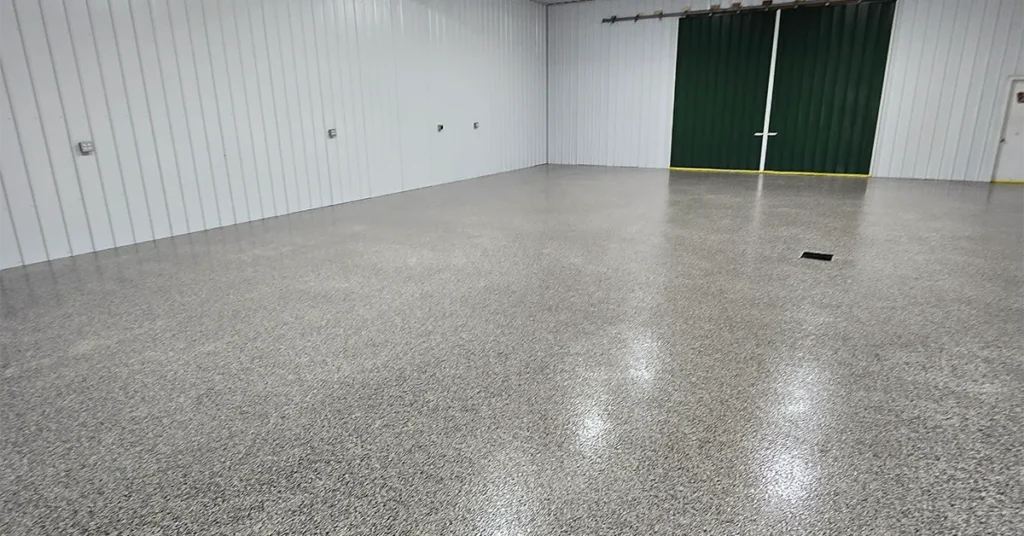
You know that shiny, tough floor you see in some garages that looks almost too good to be real? That’s probably epoxy flooring. And no, it’s not paint. It’s way more than that.
Suppose you’ve been dealing with a concrete floor that’s cracked, stained, or simply unappealing. In that case, epoxy flooring may be exactly what you need. But what is it really? How does it work? And why are so many people choosing it for their homes?
Let’s get into it.
So, What Exactly Is Epoxy Flooring?
Here’s the simplest way to explain it: Epoxy flooring is a protective coating system that gets applied directly to your concrete floor. It’s not a single product; it’s actually a system composed of multiple layers that work together.
Think of it like this. Your concrete floor is the foundation. The epoxy coating bonds to the concrete and creates a super-tough, sealed surface on top. Once it cures, you’re no longer just looking at concrete. You’ve got a completely new floor surface that’s way stronger and better-looking than what you started with.
The cool part? This isn’t some home-only product. Epoxy flooring is actually commercial-grade stuff. The same coatings used in warehouses, factories, and commercial buildings are now being used in regular homes. That should tell you something about how tough this stuff really is.
The Two-Layer System: Base Coat and Top Coat
Here’s where people get confused. When you get epoxy flooring installed, you’re typically getting two main layers.
The Base Coat
This is the foundation layer that goes directly on your concrete. For most indoor applications, such as garages, epoxy works remarkably well as a base coat. Why? Because it takes longer to cure, which sounds bad but is actually perfect.
While epoxy is curing, it’s soaking into every tiny pore in your concrete. It’s grabbing onto that surface and creating an incredibly strong bond. This is especially important when you’re parking cars on it or using the space for heavy work.
Epoxy also comes with built-in moisture protection. If you live somewhere humid or your concrete has moisture issues, epoxy handles it way better than other coatings. It won’t peel or bubble as easily when moisture tries to come up through the concrete.
The Top Coat
Now for the second layer. Most professionals don’t use epoxy for the top coat; they use something called polyaspartic. This is the protective shield that sits on top of everything.
Polyaspartic is super scratch-resistant. It doesn’t turn yellow when the sun hits it (epoxy can amber over time in direct sunlight). And it dries fast, which means you can use your floor sooner.
The best setup for most floors typically consists of an epoxy base coat (for a strong bond to concrete), decorative flakes if desired, and a polyaspartic top coat (for protection and a glossy finish).
Where Can You Use Epoxy Flooring?
This is one of the best aspects of epoxy flooring, which works in many more places than you might think.
Garages
This is the most popular spot. Your garage takes a beating from cars, tools, oil spills, and everything else that comes with them. Epoxy handles it all. Plus, no direct sunlight means the coating lasts even longer.
Basements
Basement floors are usually just bare concrete, which is cold and ugly. An epoxy coating completely transforms the space and adds the moisture protection you need below ground.
Kitchens
Yeah, you can do this in your kitchen. Some people may be surprised by this, but epoxy flooring works exceptionally well indoors. It’s easy to clean, doesn’t stain, and holds up to foot traffic.
Patios and Pool Decks
For outdoor areas, you’d typically use a full polyaspartic system (both base and top coat) because of the UV resistance. But the concept is the same: a tough coating that protects your concrete.
Driveways
Just like patios, driveways greatly benefit from coating systems. They look incredible and handle the weather way better than bare concrete.
Commercial Spaces
Showrooms, retail stores, warehouses, epoxy works everywhere. It’s designed for heavy commercial use, so using it at home is almost overkill. But that’s exactly what makes it so durable.
Understanding the Different Coating Types
Okay, so we’ve talked about epoxy and polyaspartic. Let me break down the three main types of coatings so you understand what installers are talking about.
Epoxy
Best suited for: Indoor spaces, garages, and areas without direct sunlight.
Strengths: Amazing bond to concrete, moisture-resistant, cures slowly for profound penetration.
Weakness: Can amber over time in direct sunlight
Polyaspartic
Best for: Top coats, outdoor areas with sun exposure.
Strengths: UV-stable (won’t yellow), scratch-resistant, dries fast.
Weakness: Thinner than epoxy, doesn’t bond quite as deeply.
Polyurea
Best for: Cold climates with freeze-thaw cycles.
Strengths: Super flexible, handles temperature changes without cracking. Weakness: Not as strong a bond as epoxy
Each one is a professional-grade product. None of them is cheap or of low quality. They’re just designed for different situations. That’s why professionals mix and match them: an epoxy base coat with a polyaspartic top coat provides the best of both worlds.
The Installation Process
When pros install epoxy flooring, here’s what happens:
Step 1: Surface Prep
This is make-or-break. The concrete is cleaned, ground down to open its pores, and any cracks are filled. Oil stains get treated. This step takes the most time and is the most important.
Step 2: Base Coat Application
The epoxy (or other base coat) gets mixed and applied. If you’re adding decorative flakes, they get broadcast into the wet base coat. Then it needs to cure for 12-24 hours.
Step 3: Top Coat Application
After the base cures, the top coat (usually polyaspartic) goes on. This seals everything, adds shine, and provides a final protective layer.
Step 4: Cure Time
You can usually walk on it after 24 hours. Parking cars or heavy use typically requires 48-72 hours of cure time.
The whole process takes about 3-4 days from start to finish.
FAQ’s
How long does epoxy flooring last?
With proper installation and basic maintenance, you can expect a lifespan of 10-20 years or more. In garages or indoor spaces without direct sun exposure, it can last even longer. The key is getting it installed right in the first place, as surface prep makes all the difference.
Can epoxy flooring crack or peel?
If it’s installed correctly on properly prepped concrete, cracking and peeling are rare. Problems arise when the prep work is skipped or rushed. If your concrete itself has major structural issues, those need to be fixed first.
Is epoxy flooring slippery?
High-gloss finishes can be slippery when wet, but most installers add texture or anti-slip additives to the top coat. This is especially important for garages and outdoor areas. Always ask your installer about slip resistance any good contractor will address this automatically.
What’s the difference between epoxy paint and epoxy coating?
Epoxy paint is essentially a thick coating that is applied directly to your concrete. Epoxy coating is a two-part system that chemically bonds with the concrete. Paint might last a year or two. Real epoxy coating lasts 10-20 years.
Can you do epoxy flooring over old concrete?
Yes, but the concrete needs to be in decent shape. Minor cracks and imperfections are fine, those get fixed during prep. But if your concrete is severely damaged, has major structural issues, or is extremely old and deteriorating, you might need repairs first.
Does epoxy flooring work in cold climates?
Absolutely. Epoxy itself handles temperature changes well. For areas with extreme freeze-thaw cycles, some installers use polyurea as the base coat since it’s even more flexible. The coating system gets customized based on your climate. Professional installers know what works best in your area.
Conclusion
Epoxy flooring isn’t just about making your floor look better, though that’s a nice bonus. It’s about creating a surface that actually works better. Easier to clean, tougher, moisture-resistant, and built to last.
Whether you’re tired of looking at your stained garage floor, want to finish your basement, or need a durable solution for a commercial space, epoxy flooring delivers. Commercial-grade strength is being used in homes, which tells you everything you need to know about durability.
Your floor is a bigger deal than you think. It affects how your whole space looks and functions. With epoxy flooring, you get something that works as hard as you do.